Ship AIS data completer
AIS data can have missing points due to signal interference, limited satellite or terrestrial coverage, weather conditions, and ship operations. Obstacles, low-power transponders, and poor receiver placement can disrupt transmissions, while gaps in coverage occur in remote areas. Ships may also turn off AIS for security or operational reasons, and data loss can result from network congestion or filtering by providers. Additionally, reporting intervals vary by speed, making some data appear intermittent. These factors combined lead to occasional missing AIS positions in tracking datasets.
Our approach
To ensure accurate ship trajectories, the MariTEam model applies an A* path-finding algorithm to detect and correct missing or erroneous AIS points. By constructing a navigable graph that distinguishes between water and land, the model identifies gaps in AIS data and reconstructs plausible routes based on distance, speed, and maritime accessibility. This method helps remove unrealistic points over land while maintaining logical vessel movements, improving the reliability of ship tracking and emissions modeling.
An example with the MS Spitsbergen
MS Spitsbergen is an expedition cruise ship operated by Hurtigruten, originally built in 2009 as the Portuguese ferry MS Atlântida. After being acquired by Hurtigruten in 2015, the ship underwent extensive renovations at Fosen Yard, where its car deck was removed, new cabins were added, and its stern was redesigned for improved fuel efficiency. It was officially renamed MS Spitsbergen in September 2015 and entered Hurtigruten service in June 2016. The ship is named after the largest island in the Svalbard archipelago, paying tribute to Hurtigruten’s Arctic exploration heritage.
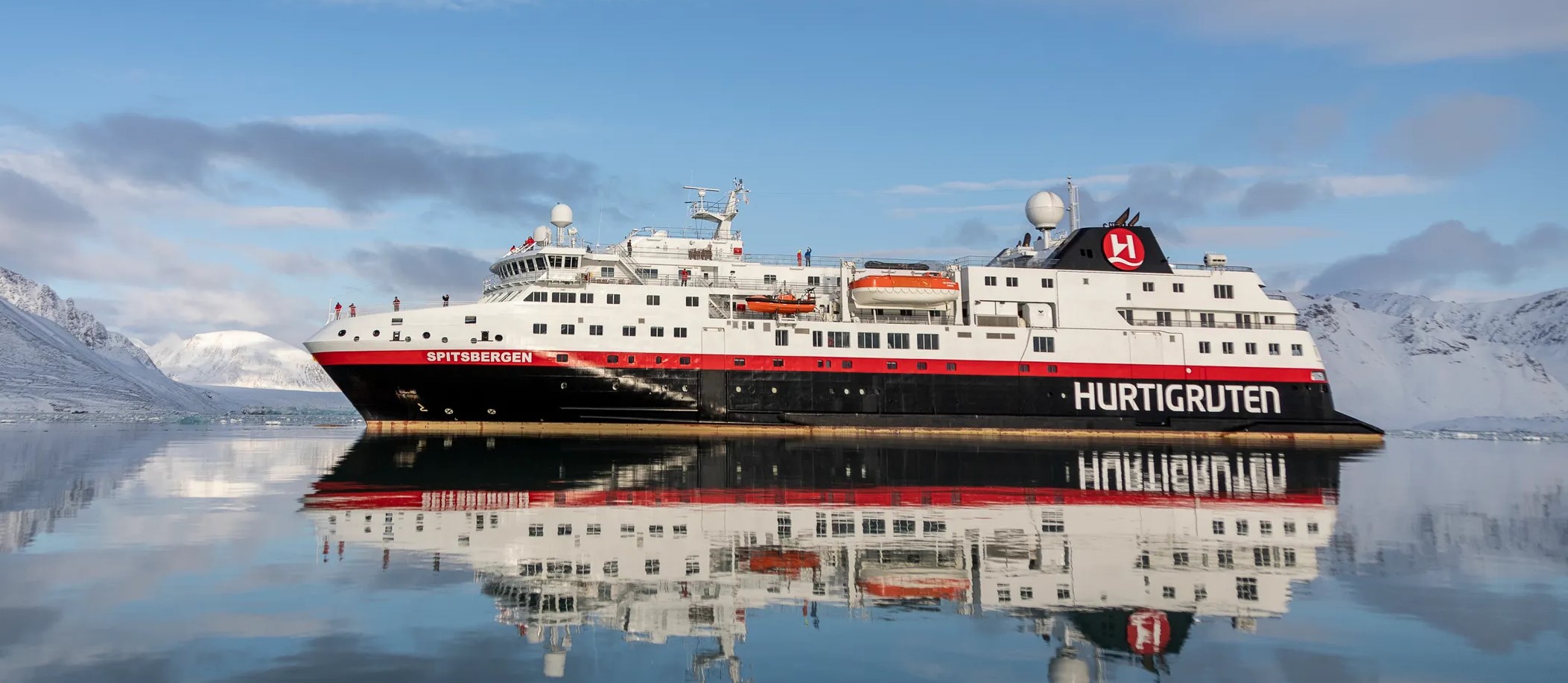
SPITSBERGEN IMO: 9434060 (source)
Designed for polar expeditions, MS Spitsbergen operates voyages to destinations such as Svalbard, Greenland, Iceland, and Canada, offering an immersive experience in some of the world’s most remote regions. It features accommodations for 335 passengers, diesel-electric propulsion system, a top speed of 16 knots, and a reinforced hull for Arctic waters.
Some of the main features of this ship are:
- Length overall: 100.54 meters
- Breadth: 18 meters
- Draught: 5.3 meters
- Deadweight: 687 tonnes
- Gross Tonnage: 7344
- Service speed: 16.4 knots
- Main engine power: 10.6 MW or 14424HP
- Built year: 2015
Results
We use the MS Spitsbergen to demonstrate our model by using data from for part of its itinerary in 2019, consisting of between Greenland, the Shetland Islands, Norway, and Svalbard. The voyage took place from Mar 02 2018 to November 22 2018, covering key maritime routes in the Arctic. This data was integral to showcasing the model’s capabilities in predicting ship trajectories, emissions, and operational conditions in these challenging environments.
Why is this so important
Completing the AIS data is paramount to ensuring a higher frequency of ship position points, which is essential for accurate interpolation with weather data from ECMWF reanalysis. AIS transmissions often have gaps due to satellite coverage limitations, signal interference, or onboard transmission settings. By filling these gaps using data completion techniques, such as trajectory reconstruction, speed and heading estimations, or machine learning-based approaches, we can create a more continuous dataset. This improved temporal and spatial resolution allows for more precise alignment with ECMWF’s gridded atmospheric and oceanic variables, such as wind speed, wave height, and sea surface temperature. Data is obtained from ECMWF Reanalysis v5 (ERA5).
Having a denser AIS dataset means that interpolated weather conditions at each ship position are more reliable, reducing uncertainty when analyzing environmental interactions with maritime activity. This is especially critical for evaluating fuel consumption, emissions, and safety risks in regions where weather conditions change rapidly. The ability to correlate ship behavior with high-resolution meteorological inputs enhances the accuracy of climate impact assessments and operational decision-making in shipping.
AIS Coverage
Ships equipped with AIS transponders can be tracked via two main methods: land-based antennas and satellite systems. Land antennas, typically installed along coastlines, have a limited reception range of only a few dozen kilometers offshore, but they generally face minimal signal interference due to the smaller number of vessels within their range. These stations are especially common in coastal areas of developed regions. In contrast, satellites can pick up AIS signals over vast areas, even from ships thousands of kilometers apart. However, in heavily trafficked maritime zones like Southeast Asia, the sheer volume of overlapping signals can lead to interference, reducing the effectiveness of satellite-based AIS tracking compared to areas with fewer vessels.
Cleaning the faulty points that stem from interference and completing the distance between two points to a shorter interval is essential. The map below shoes the percentage of points in our dataset that are “completed” and have been interpolated, as opposed to the original AIS data. Because our AIS data has been obtained by Kystverket, the Norwegian Coastal Administration, one can see that the Norwegian coast does not required much completion (white area around the coast) due to the inclusion of land-based antennas, as opposed to the other adjacents regions that solely rely on satellite data.
Author: Diogo Kramel
Model: MariTeam model
Submodel: Ship Track Completer
Repository: GitHub
Data Version: v1.0.0 | 2020-01-07
Page Latest Update: March 24, 2025
Contact: diogo.kramel@ntnu.no