Validation of results
In our work, we have compared the results from the model with both measured and reported data to ensure its accuracy and reliability. Two key examples highlight this validation process: first, we compared the model’s output with in-service data from a gas tanker provided by one of our partners, allowing us to assess the model’s performance in a real-world operational context. Second, we cross-referenced the model’s predictions with reported data from the EU Monitoring, Reporting, and Verification (EU-MRV) system, which provides standardized emissions data for ships operating within the European Union. These comparisons help validate the model’s ability to reflect actual operational conditions and improve its credibility in predicting emissions and performance.
Comparison with in-service data
The first example is the comparison between the MariTEAM model’s power demand estimations and the power measured at the shaft of an operating ship. The ship in question is the LNG carrier BW Tulip, and data for the year 2019 has been kindly provided by our former partner BW Gas in the CLIMMS project.
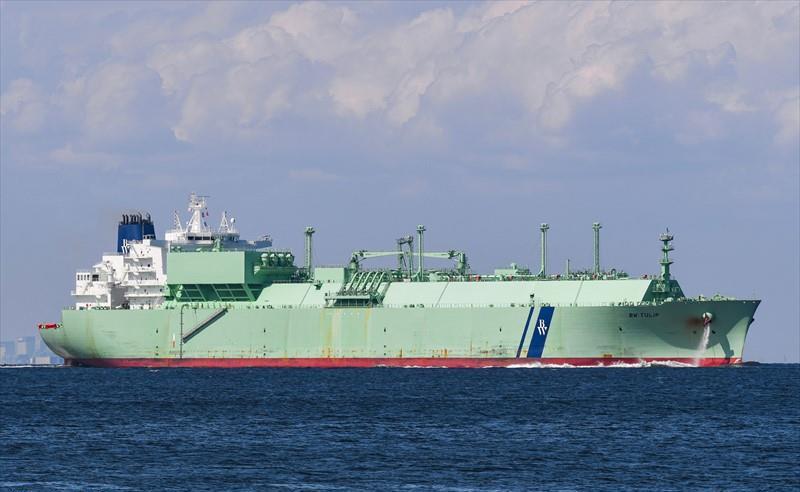
BW Tulip IMO: 9758064 (source)
We compared the two in the plot below, which visually demonstrates the accuracy of the model’s power demand predictions against the actual measurements from the ship. This comparison highlights the model’s ability to estimate power demand in real-world operating conditions.
While no model can capture with absolute precision the energy demand of a ship, especially given the numerous weather and environmental factors that influence performance, the MariTEAM model provides estimations that are remarkably close to actual measurements. Despite the inherent complexity of accurately predicting energy demand, the model effectively captures the overall trends, including both the peaks and troughs in power consumption. It not only aligns with higher energy demand moments but also reflects periods of lower demand, showcasing its robustness in accounting for the dynamic fluctuations in a ship’s energy requirements across varying operational conditions. This balance between high and low energy demands demonstrates the model’s reliability and its capability to mimic real-world scenarios with a high degree of accuracy.
MRV comparison
In our analysis, we also compared the annual emissions for each ship with the emissions reported by the EU-MRV scheme, MRV – Monitoring, Reporting and Verification, which provides emission data for ships sailing to and from the EU and the UK. Specifically, we focused on comparing the energy demand from trips to Europe. While our analysis primarily considers the energy consumed during these trips, it does not delve into the complexities of fuel bunkering that may occur mid-voyage, which could affect the emissions calculation. Despite these differences, our results demonstrate a high level of trustworthiness when compared to the EU-MRV data. This suggests that, even without accounting for the full intricacies of fuel transfers, our emissions estimates for ships are robust and reliable, aligning closely with the data reported by the EU-MRV scheme.
The plots below show the distribution of the Annual Efficiency Ratio (AER) given in gCO2/DWT/nautical mile for differente ship types, with the results from the MariTeam model in the bottom compared to the benchmarking values of EU-MRV on top.
Author: Diogo Kramel
Model: MariTeam model
Repository: GitHub
Data Version: v1.0.0 | 2025-02-13
Latest Update: March 24, 2025
Contact: diogo.kramel@ntnu.no